
Real Estate Boiling! EEC Act Unlocks Foreigners to Hold 100% Land and Condo Ownership
3 EEC Provinces Spread Their Wings with New Law Unlocking Real Estate, Opening Path for Foreigners to Own Land, Hold 100% Condo Ownership. Thai and Foreign Landlords Rejoice as Government Opens Applications for Special Economic Zone Establishment with Plenty of Benefits. Chinese Capital Actively Moving, Competing with Japanese Investment in EEC, Finalizing 4 Zones within 60 km Radius of Digital Park as Rising Star Location. “JLL” Points Out Industrial and Logistics Booming, “Residential, Hotel, Retail, Office” in Hot Demand.
Sources from the real estate industry revealed to “Prachachat Business” that the push for the Eastern Economic Corridor (EEC) development project, which the government is accelerating, and most recently, the Eastern Special Development Zone Act B.E. 2561 (2018), has been in effect since May 15, 2018.
In addition to boosting confidence and enabling Thai and foreign business investors to decide on investing in 10 target industries, this new law also benefits trade and service businesses across multiple sectors, especially the real estate business. After the said Act came into effect, increased movement from both Thai and foreign real estate capital has been observed, including inquiries to brokers, real estate agents, consulting firms, and preparations to purchase land to support investment.
Foreigners Hold Land and Condo Ownership
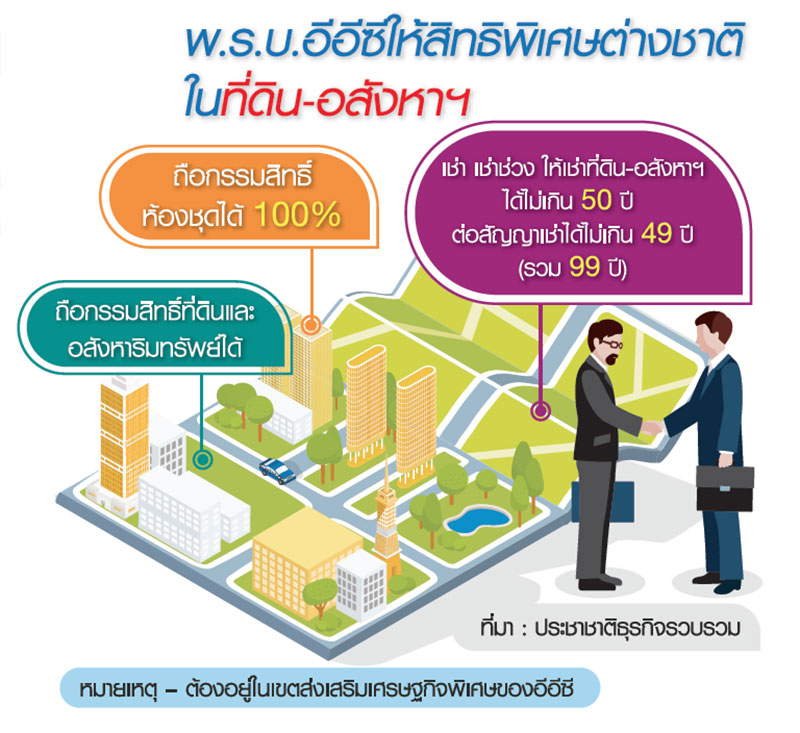
The EEC Act grants aliens and alien juristic persons in the 3 EEC provinces, namely Chonburi, Rayong, and Chachoengsao, special rights regarding land and real estate as follows: 1. Operators in the Special Economic Zone who are juristic persons and aliens under the Land Code are entitled to hold ownership of land within the promotion zone to conduct permitted business operations, without requiring permission under the Land Code.
2. Operators in the promotion zone who are juristic persons and aliens under the Condominium Act are entitled to hold ownership of condominium units, exempted from the ownership restrictions under the Condominium Act.
Currently, aliens can acquire land for residential purposes not exceeding 1 rai, subject to permission from the Minister of Interior, and must bring in investment funds of no less than 40 million baht into Thailand. As for condominium unit ownership, the law allows aliens to hold no more than 49% of the total condominium unit area in a condominium building.
However, if the ownership of land, real estate, and condominium units as mentioned is not used for business operations within 3 years or business operations cease, the land must be disposed of within 1 year. Otherwise, the EEC Office has the authority to order the disposal of such land.
Lease Land and Real Estate for 99 Years
The new law also stipulates that leasing, sub-leasing, granting leases, or granting sub-leases of land or real estate in the promoted area for investment in 10 target industries, namely: 1. Next-generation automotive 2. Smart electronics 3. Affluent medical and wellness tourism 4. Agriculture and biotechnology 5. Food processing
6. Robotics 7. Aviation and logistics 8. Biofuels and biochemicals 9. Digital 10. Comprehensive medical and healthcare. This can be done without being subject to the Civil and Commercial Code, which allows lease contracts for no more than 30 years with renewals for no more than 30 years. It is also exempt from the Act on Lease of Immovable Property for Commercial and Industrial Purposes, which allows leases exceeding 30 years but not exceeding 50 years, with renewals for no more than 50 years.
As for leasing state land, leasing, sub-leasing, granting leases, or granting sub-leases is not considered a joint venture under the law on private participation in state undertakings, unless the EEC Board resolves to consider it as a joint venture on a case-by-case basis.
Landlords Set Up Promoted Zones
In addition, the EEC Act allows landowners with land located in the 3 provinces, namely Chonburi, Rayong, and Chachoengsao, to apply for the EEC Office to designate their land as a special economic zone, provided it meets the specified criteria and conditions.
That is, the area must be engaged in any one of the 10 target industries, or other industries promoted to create related businesses, or beneficial to the development and promotion of target industries, or to facilitate the transfer of knowledge and expertise, which may include service industries, tourism and convention industries, or others.
Regarding the process for landowners to apply for the EEC Office to declare their qualifying land as a special economic zone, the law does not specify whether the landowner must be Thai or foreign. This effectively opens the door for both Thais and foreigners who own land to apply for the establishment of a special economic zone.
China Edges Out Japan in EEC Investment
Mr. Rachapoom Jongpakdee, General Manager of Colliers International (Thailand) Co., Ltd., revealed to “Prachachat Business” that the EEC Act, which has just come into effect, is attracting significant interest from many foreign real estate investors. The most prominent group at present is Chinese investors, estimated to account for 70% of foreign investors likely to flow into the EEC's 3 provinces, followed by the Japanese group, which has an existing base of same-nationality customers who have invested in factories scattered across current industrial estates.
The reason Chinese investors are interested in investing in Thailand partly stems from the Chinese government's One Belt One Road policy, which has reduced investment in the United States and shifted focus toward Eastern Europe and Asia. The EEC zone has thus become one of the investment targets.
“Previously, since the government promoted the EEC, many foreign investor groups have inquired. But it was at the stage of studying investment opportunities. With the latest update of the new law being enacted, they have inquired again. Now, what we are waiting for is the key law to be issued. We still need to wait for the EEC Policy Committee to be established. And most importantly for the real estate sector, it is the city plan, which requires canceling the old plans and announcing a new regional city plan or provincial plan.”
Based on the current problems with the city plan, it is found that the EEC covers 3 provinces, but some city plans have expired, some are still in force, and some are comprehensive provincial plans, which makes this entire zone inconsistent.
4 prominent zones within a 60 km radius
In terms of emerging locations, or zones for foreign customers, the key consideration is being close to employment sources, educational institutions, and shopping areas. Therefore, the focal point is at Digital Park. From there, expanding the travel radius within half an hour, or within a 60-kilometer radius, results in 4 prominent zones, including: 1. Suan Sri Racha zone, 2. Assumption Sri Racha zone, 3. Laem Chabang Port zone, and 4. Sahapatana Industrial Estate zone.
Regarding investment deals by foreign investors, Mr. Rachaphum said that the Chinese group is the most active at present. Some have already purchased land, and some are in the process of negotiating land purchases, ranging from less than 100 rai to 500 rai. Negotiations started since late 2017, with 6-7 parties involved. Recently, 3 new groups have joined. The investment value stands at 30,000 million baht. Within 5 years, Chinese investment is expected to reach 50,000 million baht. The preferred project types are mixed-use and condominiums, with the Chinese investing themselves and selling to Chinese customers.
Meanwhile, Japanese investor groups have 1-2 deals studying investment in low-rise projects, particularly single detached houses, because before the EEC Act was announced, real estate purchases
were restricted to buying ownership rights only for condominiums. Currently, the new law unlocks the ability for aliens, both individuals and juristic persons, to purchase land without restrictions under the Land Code, provided they are within the announced promoted zone. This means it is open to purchasing ownership rights for low-rise projects, with formats including community malls within the projects as well.
Suggests the government establish zones and control quotas
However, Mr. Rachaphum said that the policy to promote the EEC is something investors have been waiting for a long time. But in the long run, there should be measures to support Thai operators as well, because their investment capacity is not as strong as
Foreigners view the opening up of the EEC area, which covers 3 provinces, as not necessarily requiring 100% opening. It may be designated as zoning where foreigners can invest and sell on their own, perhaps with a 10-30% proportion, to reserve space for Thai operators as well.
“Under the EEC Act, Chinese and Japanese investors no longer need to joint venture with Thais. They can buy land, develop projects, and sell on their own 100%. However, everyone knows what needs to be done to support the new industrial estates. Many have bought land banks to wait for project development, but actual investment depends on the industrial estates being established first and how many people will work there. Residential business cannot be built before there is demand, as it would be an investment risk.”
JLL Opens Deal for 1,500 Rais of Land
Mrs. Supin Meechuchit, Managing Director of Jones Lang LaSalle Thailand (JLL), revealed that recently, she was contacted by 5 large landowners with plots of 100-600 rais, totaling 1,500 rais in Chonburi, such as Bang Sare, to open investment deals. The formats include both joint ventures (JV) and land sales. Chinese investors have also contacted to study investment opportunities, and Thai developers want to open deals for project development of all types, including residential and income-generating rental businesses.
“The EEC Act has just come into effect. It is believed to stimulate more activity among real estate investors. However, in the initial phase, industrial and logistics properties are expected to be the real estate sectors with high growth in the EEC, followed by other real estate sectors, including residential, hotels, retail, and offices. Most Thai and foreign investors are still in the assessment phase.”
JSP Puts 2.9 Billion Baht Land Up for Sale
Mr. Pairote Wattanavoradit, Managing Director of JSP Property Public Company Limited, said that in the EEC zone previously, the company announced a joint investment plan with the Zhongtian Construction Group to develop the Bang Sare project, with a project value of 15,000 million baht. Update on the situation:
The company has undergone a change in major shareholders and adjusted its new policy, no longer investing in large-scale projects. The focus is on building fast and selling fast. Therefore, the Bang Sare land project development has been halted, and the entire 161-rai plot has been put up for sale. The location has frontage on Sukhumvit Road, rear access to the sea, near Cartoon Network and Nong Nooch Garden. The average price is 16 million baht per rai, with a total value of 2,600-2,900 million baht.
Alongside reducing the scale of project development from 10-billion-baht projects to billion-baht projects, the company is looking for land banks of 30-50 rais to develop low-rise projects priced at 2-4 million baht. The focus is on locations near Assumption College, Sriracha, because of the advantage of having international schools, which makes it convenient for foreign executives to live. It is also close to Digital Park, with a travel time of half an hour or no more than 60 km.
“Sriracha has a magnet in international schools and shopping at Robinson. Currently, we invested in townhouses and achieved success. The main customers are Thais working in industrial estates. New projects are expanding to include more foreign customers.”
Origin invests billions in 2019”
Mr. Peerapong Jaroon-ek, Chief Executive Officer of Origin Property Public Company Limited, said that the EEC Act is like a bonus for entrepreneurs. Previously, 10,000 million baht was invested. The company is increasing its role in EEC locations further, targeting 20-30% of total revenue portfolio. By 2019, it plans to invest an additional 10,000 million baht.
“Actually, we had already turned our direction that way. We have condos, hotels, serviced apartments, and retail. The location is still in Chonburi, 2 km from the Digital Park. Going forward, we will cover all 3 provinces, expanding to Rayong and Chachoengsao as well. Currently, we have a 30-rai land bank at the Non Samlee intersection or the Map Ta Phut intersection, which will be a large project. As for Chachoengsao, it may focus mainly on single-detached houses.”
“For the EEC zone, we emphasize employment hub locations, with Thai customers as the main target, priced at 1-4 million baht. We haven't done resort condos yet, but if the opportunity to welcome foreign customers opens up like this, I will definitely do every segment,” said Mr. Peerapong.
Thanks for images and news from Prachachat Business
https://www.prachachat.net/property/news-162188