
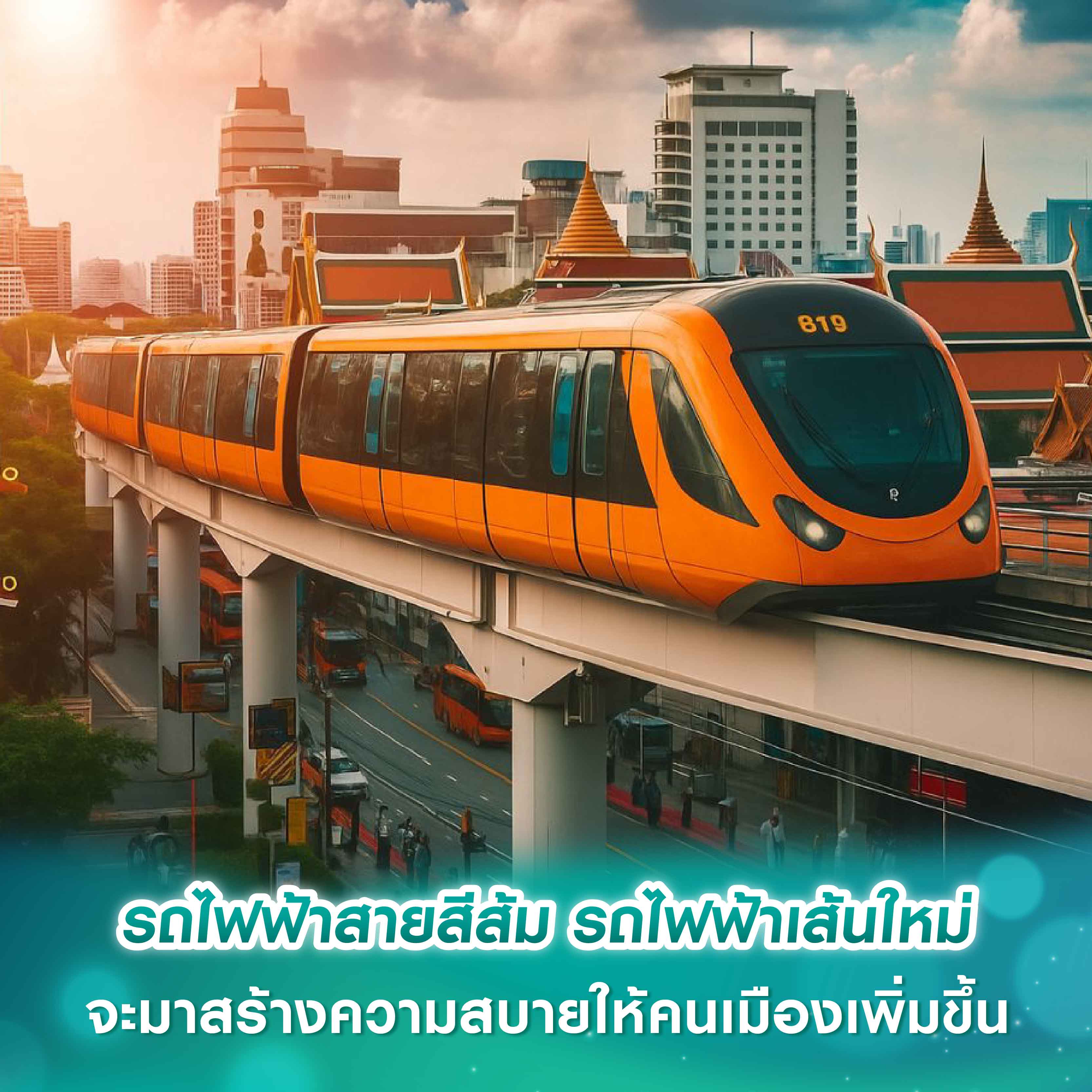
The Orange Line electric train is one of Bangkok's mass transit projects, managed by the Mass Rapid Transit Authority of Thailand (MRTA). It will add train routes covering the eastern and western zones of Bangkok, bringing easier and faster travel to people who previously had limited transport options and had to endure traffic congestion.
Where can the route take you?
The Orange Line electric train has a total of 28 stations, divided into 2 sections.
Western Section (Bang Khun Non - Thailand Cultural Centre)
This section has 11 stations, all of which are underground stations.
-
Bang Khun Non Station
-
Siriraj Station
-
Sanam Luang Station
-
Democracy Monument Station
-
Lan Luang Station
-
Yomarat Station
-
Ratchathewi Station
-
Pratu Nam Station
-
Ratchaprarop Station
-
Din Daeng Station
-
Pracha Songkhro Station
-
Thailand Cultural Centre Station
Eastern Section (Thailand Cultural Centre - Min Buri)
This section has 17 stations: 10 underground stations and 7 elevated stations.
-
Thailand Cultural Centre Station
-
Mass Rapid Transit Authority of Thailand (MRTA) Station
-
Wat Phra Ram 9 Station
-
Ramkhamhaeng 12 Station
-
Ramkhamhaeng Station
-
Sports Authority of Thailand Station
-
Ramkhamhaeng 34 Station
-
Lam Sali Intersection Station
-
Si Burapha Station
-
Khlong Ban Ma Station
-
Sam Makon Station
-
Nom Klao Station
-
Rat Phatthana Station
-
Min Phatthana Station
-
Khet Ramkhamhaeng Station
-
Min Buri Station
-
Rom Klao Intersection Station
How will the Orange Line electric train answer the travel needs of people in this area?
The Orange Line electric train is a main route running from Bang Khun Non—or as we familiarly call it, the Thonburi side—all the way to Minburi. Anyone living in this area knows full well that it is a heavily congested road. Of course, traffic problems plus the arrival of the electric train will allow people in these areas to travel into the city center faster
without having to drive through completely gridlocked traffic on Ramkhamhaeng Road, while the routes on the Thonburi side are just as bad. The new electric train line will encourage more people to travel by train because it is faster, which will also reduce the number of cars on the road. And traveling by electric train, as we all know, inevitably saves travel time. Moreover, for those living in the suburbs, traveling by electric train is certainly much faster than driving themselves.
The Orange Line is not just a single route, but also a hub connecting with several other electric train lines, making travel even more convenient.
-
Thailand Cultural Center station connects with the Blue Line electric train (MRT)
-
Lam Sali intersection station connects with the Yellow Line electric train
-
Minburi station connects with the Pink Line electric train

Approximately how much is the fare?
Since the Orange Line electric train project is still under construction and has not yet officially opened for service, the fare to be charged is not yet confirmed. However, the fare structure is expected not to differ much compared to the Green Line that runs through Siam.
-
The fare is expected to be charged based on distance traveled, with a starting rate of approximately 15 - 17 baht and a maximum rate of approximately 45 - 62 baht. Of course, this is a fare rate similar to other MRTA electric train lines, such as the Blue Line, Pink Line, and Yellow Line
-
The fare calculation method uses a distance-based fare system. When traveling across lines within the MRTA network, you only pay the entry fare once.
Payments and travel cards can be made through several channels, including
-
Travel cards are expected to support cards in the EMV system (Europay, Mastercard, Visa). Contactless credit or debit cards with the VISA or Mastercard symbol can be used for tap-to-pay.
-
The BTS card, also known as the Rabbit Card, unfortunately is expected to be unusable. Normally, the Rabbit Card can only be used on the BTS Skytrain and BRT buses, and cannot be used on trains in the MRTA network (MRT), such as the Blue Line, Purple Line, Yellow Line, and Orange Line.
How many trains are there, and how many minutes apart?
The Orange Line electric train plans to use a total of 32 train sets, which will be gradually brought in to first serve the eastern section of the route. As for service frequency, the train frequency is expected to be appropriate for service hours in the following format
-
Morning rush hours 06:00-09:00 and evening 16:30-19:30, with a frequency of no more than 5 minutes per train
-
Off-peak hours, with a frequency of no more than 10 minutes per train
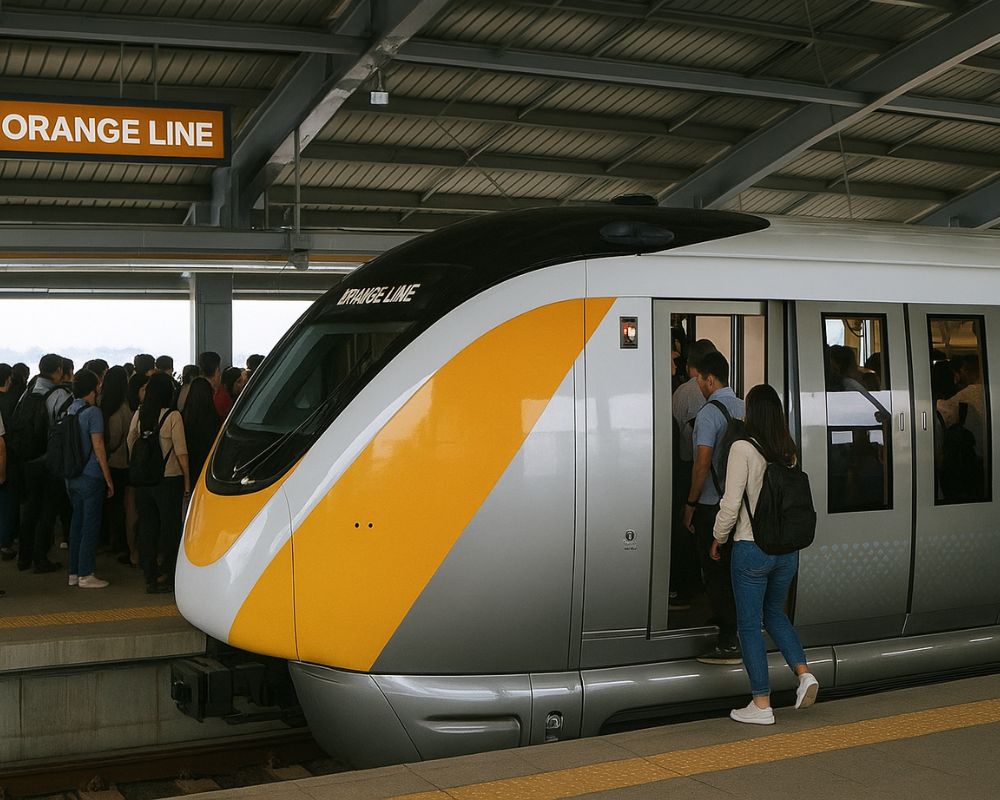
Advantages of the Orange Line Electric Train
Advantages
-
Key transportation connectivity – without a doubt, wherever there is an electric train, that area becomes a hub of urban prosperity that society moves toward. At night, there is no need to worry; every trip is easy. No need to charter a taxi, no need to endure sitting on a bus that comes only once in a while, plus having to gamble with traffic lights that stay red for an extremely long time before reaching your destination. The Orange Line electric train is a main route directly connecting eastern Bangkok (Min Buri) to the city center and the western side (Bang Khun Non). These routes are certainly important – the more areas they reach, the more convenient cross-city travel becomes.
-
Reduces traffic problems – of course, an electric train running above ground has no traffic lights, with clear travel times. This advantage helps greatly reduce the stress of traffic congestion on Ramkhamhaeng Road and other major routes.
-
Multiple interchange points – the Orange Line electric train deserves praise for doing it well and thoroughly, as passengers can connect with several other electric train lines, such as:
-
Blue Line (MRT) at Thailand Cultural Centre Station
-
Yellow Line at Lam Sali Junction Station
-
Pink Line at Min Buri Station
-
Disadvantages
-
Project delays – even though construction is complete, it does not mean it is in use yet. Anyone following the news will see that the Orange Line electric train project has faced bidding problems for a long time, causing the construction on the western side to remain unfinished, while the completed eastern section still cannot open for service as originally planned.
-
Impacts during construction – naturally, more construction means more severe ground-level traffic congestion, causing inconvenience to people traveling through the area.
The Orange Line electric train is considered a train project that wins the hearts of suburban residents without cars, or those who may have one but are too lazy to drive and don’t want to waste time stuck in traffic on the roads. The arrival of the Orange Line electric train service will make these people more part of urban society, no longer far from traveling with gums exposed to sun and rain, because they will use the train service sitting comfortably in air-conditioned cars, arriving home comfortably in just a few minutes, with time to rest and live an easier life. And it answers that question well – whenever the electric train arrives, prosperity follows as well